
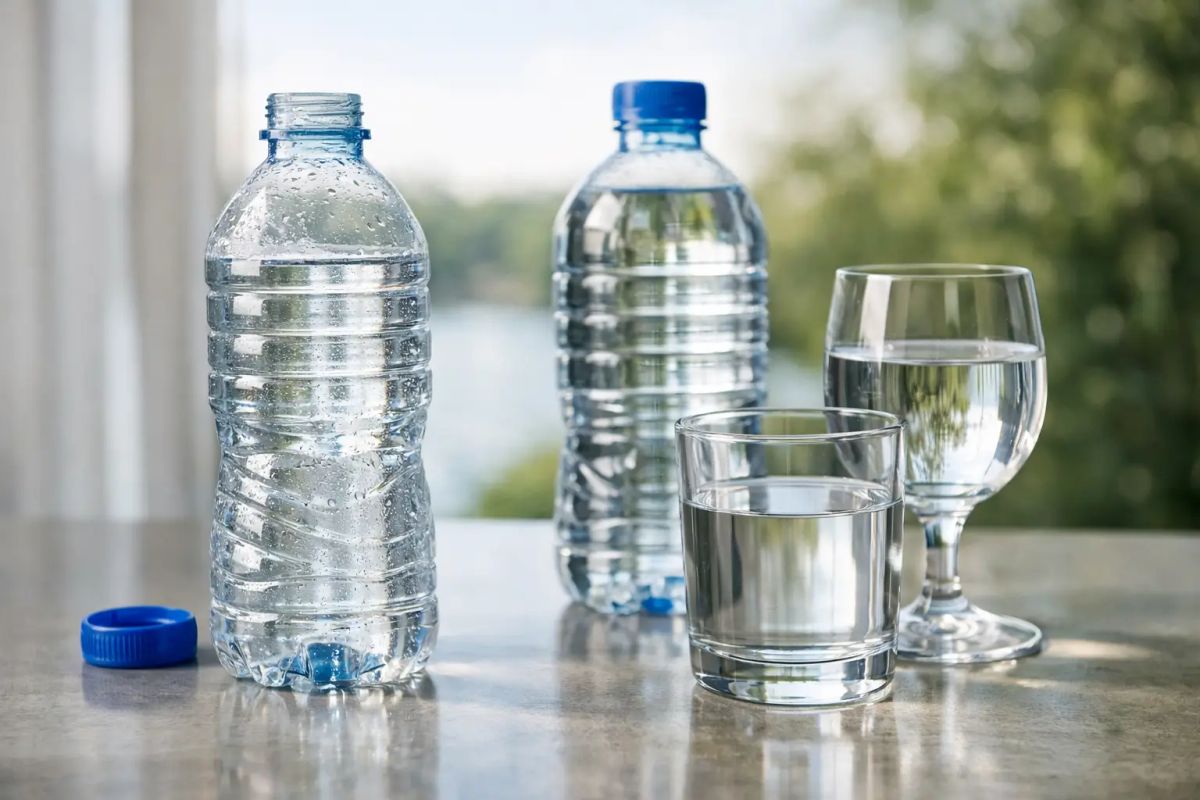
A bottle opened beside a delicate crudo can taste soft and almost sweet. The same water, served ice-cold after a run, may seem nearly flavorless. Then another bottle arrives with a stony, crisp edge or a faint saline finish. Why does bottled water taste different? Because water is not a blank canvas. There is a world inside every bottle: minerals, geology, dissolved gases, temperature, and the decisions made between source and table.
For people who pay attention to coffee, wine, or olive oil, this is a familiar idea. Origin leaves a signature. With water, that signature is often quieter, but it is no less real.
Why Does Bottled Water Taste Different From Brand to Brand?
The largest factor is mineral composition. As water moves through rock, soil, and underground aquifers, it dissolves small amounts of naturally occurring minerals. The resulting balance of calcium, magnesium, sodium, bicarbonate, sulfate, chloride, and silica creates a sensory profile as distinct as a wine's structure.
Total dissolved solids, usually shown as TDS, offers a useful starting point. It measures the combined concentration of dissolved material in water, typically in milligrams per liter. Low-TDS waters often feel light, clean, and quick on the palate. Higher-TDS waters tend to carry more weight and a longer finish. But TDS is not a scorecard. Two waters with the same number can taste dramatically different because the minerals themselves matter more than the total alone.
A calcium-forward water can feel firm, chalky, or gently creamy. Magnesium often brings a drier, more mineral-driven character, sometimes with a subtle bitterness at higher levels. Bicarbonate can soften the impression of acidity and create a round, smooth texture. Sodium may register as faintly savory, while sulfate can add an assertive, crisp, dry finish. Silica is often associated with a silky, polished mouthfeel.
This is why the phrase “pure water” can be misleading in a tasting sense. Chemically minimal water has a place, especially when a neutral profile is desired. Yet naturally mineralized water can offer dimension, texture, and a sense of place. Neither is automatically better. It depends on what you enjoy and what is on the table.
Source geology gives water its terroir
Spring water, artesian water, glacier-fed water, and mineral water can begin in very different environments. Water passing through limestone may develop a calcium and bicarbonate profile that feels round and structured. Volcanic geology can contribute a more pronounced mineral character, occasionally with silica-led smoothness. Deep aquifers may produce a water with greater density and persistence.
The source description alone does not tell the entire story. Two spring waters can be entirely unlike one another. The useful question is not simply where the water comes from, but what it encountered on its journey there.
Carbonation Changes More Than Texture
Still and sparkling versions of the same water rarely taste identical. Carbon dioxide creates carbonic acid when dissolved in water, giving sparkling water its bright, prickly sensation. That lively acidity can sharpen aromas, lift salt, and make a mineral profile seem more vivid.
Fine, persistent bubbles tend to feel elegant and creamy, while larger, more forceful bubbles read as energetic and refreshing. Natural carbonation and added carbonation may also present differently, though serving temperature and bubble size can have as much influence as the source of the gas.
A sparkling water with substantial bicarbonate and calcium can feel almost architectural: structured, chalky, and long on the finish. A lightly mineralized sparkling water can be more delicate, with the bubbles taking center stage. In food service, this distinction matters. Bright, high-effervescence water can cut through rich dishes, while gentler carbonation is often more comfortable beside subtle seafood or fresh vegetables.
Temperature Can Hide or Reveal Flavor
Very cold water suppresses flavor perception. That is why a bottle straight from an ice bucket can seem cleaner and less expressive than the same water allowed to warm slightly. As it approaches cellar temperature, usually around 50 to 55°F, mineral notes become easier to identify and the mouthfeel becomes more apparent.
This does not mean every bottle should be served less cold. A brisk, cold pour is part of the pleasure of a light still water or crisp sparkling water. But if you want to understand a water rather than simply refresh with it, avoid serving it at near-freezing temperatures.
Try tasting two small pours: one chilled, one left out for 10 minutes. Notice the first impression, the texture across the tongue, and what remains after you swallow. A low-mineral water may stay clean and fleeting. A more mineralized water may reveal sweetness, salinity, or a stone-like finish that was invisible when colder.
Packaging and Storage Affect the Experience
The bottle is not merely a vessel. Glass, aluminum, and plastic create different expectations and, under certain storage conditions, can influence how a water is perceived. Glass is prized in fine dining because it is neutral, preserves carbonation well, and presents the water without competing visual cues. Aluminum protects water from light and is convenient, although its format can change the drinking experience through temperature and the shape of the opening.
Plastic is lightweight and practical, but warmth and prolonged storage can affect freshness perception. A bottle left in a hot car or direct sun is unlikely to deliver the same clean experience as one stored cool and away from light. For sparkling water, the closure matters too. Once opened, carbonation dissipates, changing both the texture and the balance of flavors.
There is another layer: context. Drinking from a fine glass makes it easier to notice aroma, effervescence, and texture. Drinking quickly from a narrow bottle opening mutes some of those cues. The water may be the same, but the ritual is not.
A Simple Way to Taste Bottled Water
You do not need a formal tasting room to develop a sharper palate. Start with two or three waters at a time, ideally with different mineral levels or one still and one sparkling. Use plain, odor-free glasses and taste before coffee, citrus, or strongly seasoned food.
Look first. Is it still or highly effervescent? Then take a small sip and let it move across your palate. Ask whether it feels light, round, creamy, crisp, dry, saline, or dense. Swallow and pay attention to the finish. Does it disappear immediately, or does it leave a clean mineral trace?
The language does not have to be perfect. “Soft,” “stony,” “silky,” and “brisk” are useful observations. Over time, patterns emerge. You may find that you prefer a low-mineral still water at your desk, a sparkling water with more structure alongside pizza or aged cheese, and a quiet, balanced water with a refined meal.
For a more precise read, Water Sommelier lets you scan a bottle and see the composition behind the sensation - calcium, magnesium, sodium, bicarbonate, pH, TDS, source origin, and a tasting profile. Point. Shoot. Know. The point is not to turn every sip into a test. It is to give your own preferences a vocabulary.
The Best-Tasting Bottled Water Is Personal
There is no universal winner because taste is shaped by occasion as much as chemistry. A high-mineral water that feels satisfyingly complex with a steak may seem overpowering during a quiet morning. A feather-light water may be perfect with sushi but get lost next to a deeply flavored dish. Carbonation, serving temperature, glassware, and even what you ate beforehand all influence the result.
The next time a bottle tastes unusually smooth, sharp, savory, or weightless, pause before calling it simply “good.” Notice its character. Every bottle is an invitation to taste the landscape it came from - and to choose the one that belongs in that particular moment.
Scan any bottle. Discover its minerals, origin, and character. Get the Water Sommelier app