
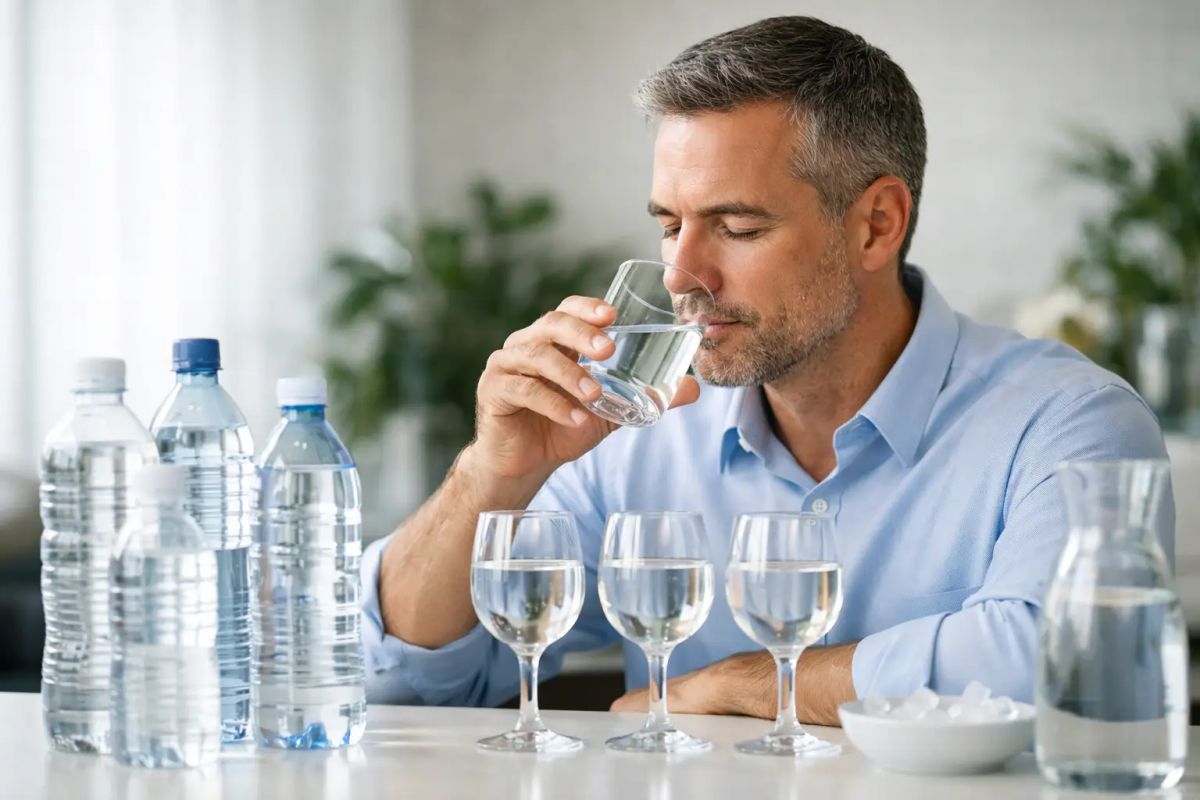
The first surprise in learning how to taste bottled water is that most people have already noticed the differences - they just have not had the language for them. One bottle feels silky, another sharp. One disappears quickly, another lingers with a faint saline or chalky impression. Water is subtle, but it is not neutral. There is a world inside every bottle.
Treating bottled water as a tasting subject changes what you notice. Source matters. Mineral composition matters. Temperature matters. Even the shape of the glass can affect your attention. Once you start tasting with intent, bottled water stops being a commodity and starts becoming an expression of place, structure, and balance.
How to taste bottled water with more precision
Start with the right setup. Taste water in a clean, clear glass, not straight from the bottle. Glass helps you perceive texture and aroma more accurately, and it removes the distraction of packaging. If you are comparing multiple waters, use identical glasses and pour the same amount into each one.
Temperature is one of the biggest variables. Ice-cold water hides detail. Very warm water can make certain mineral notes feel exaggerated. The sweet spot is cool, not frigid - cold enough to feel refreshing, but warm enough to let the water speak. If a bottle has been in the refrigerator for hours, let it sit for a few minutes before tasting.
Your palate should also be neutral. Taste before coffee, citrus, mint, or spicy food if possible. If you are tasting more than one water, move from lighter, lower-mineral profiles to richer, higher-mineral ones. That progression makes contrast easier to read.
What you are actually tasting
When people ask how to taste bottled water, they often expect a single note, like crisp or smooth. In reality, water tasting has several layers. The most immediate is texture, sometimes called mouthfeel. Some waters feel soft and rounded. Others feel dense, brisk, creamy, dry, or almost sparkling even when still. That sensation often comes from dissolved minerals and the way they interact on the palate.
Then there is taste itself. Water can register as faintly sweet, saline, alkaline, metallic, chalky, or stony. These are not flaws by default. They are sensory cues that point back to geology and mineral balance. Calcium may read as structured or chalky. Magnesium can sharpen the profile and add a slight bitter edge in some waters. Sodium may create a gentle softness or savory impression. Bicarbonate often contributes roundness and calm.
Finally, there is the finish. Does the sensation vanish quickly, or does it linger? A short finish can feel clean and brisk. A long finish can feel complex and gastronomic. Neither is automatically better. It depends on context, preference, and what you are pairing with it.
Look before you sip
Yes, even with water. Clarity should be pristine. The pour should look bright and alive in the glass. In sparkling water, pay attention to bubble size and behavior. Fine, persistent bubbles tend to feel elegant and integrated. Larger, more aggressive bubbles can come across as louder and more forceful.
Visual cues do not tell you everything, but they set the stage. Tasting begins before the first sip.
Notice the first contact
Take a modest sip and let it move across your mouth. The first contact often reveals whether a water feels soft, pointed, velvety, or taut. Do not swallow immediately. Hold it for a second or two, then let it travel over the tongue.
This is where many people first detect texture. Think of the difference between skim milk and cream, or between a polished river stone and a sheet of glass. Water does not need bold flavor to have a distinct structure.
Focus on the mid-palate and finish
After swallowing, pause. The finish is where mineral character often becomes most obvious. You may notice a clean mineral snap, a saline trace, a chalk-like dryness, or a smooth fading softness. That aftertaste is not an afterthought. It is one of the clearest signatures a bottled water has.
If you are comparing bottles, return to the first glass after tasting the second. Contrast reveals details that disappear in isolation.
A simple framework for tasting bottled water
Professionals often use consistent tasting language because it helps turn a vague impression into something memorable. A useful framework is texture, intensity, balance, and finish.
Texture asks how the water feels. Is it light, silky, creamy, structured, or brisk?
Intensity asks how present the mineral profile feels. Some waters are whisper-quiet. Others make a clear statement.
Balance asks whether the components feel harmonious. A mineral-rich water can still feel elegant if nothing sticks out awkwardly.
Finish asks what remains after the sip. Is it short, long, dry, saline, clean, or softly sweet?
This is also where bottle labels become more meaningful. pH, TDS, and mineral content are not abstract numbers once you connect them to sensation. Higher TDS often means more presence on the palate, but not always more pleasure. Some low-mineral waters are beautifully pure and restrained. Some high-mineral waters are thrilling with food but too assertive for casual sipping. Taste is context.
Why source and minerals change the experience
Bottled water carries the story of where it comes from. Snowmelt, glacial aquifers, volcanic terrain, limestone geology, and deep artesian sources can all create very different sensory profiles. This is water's version of terroir - the way place expresses itself in the glass.
That does not mean you need to memorize geology to taste well. It simply helps to understand that flavor and texture are not random. If one still water feels especially soft and another feels stony and structured, the difference usually traces back to mineral composition and source origin.
For curious drinkers, this is where analysis becomes powerful. Using a tool like Water Sommelier can help connect what you taste to what is actually in the bottle - calcium, magnesium, sodium, bicarbonate, pH, TDS, and source details. That information does not replace sensory experience. It sharpens it.
Common tasting mistakes
The most common mistake is tasting water too cold. Very low temperature mutes character, especially in still water. The second is rushing. Water rewards attention, but only briefly. A few quiet seconds with each sip are often enough.
Another mistake is assuming more minerals always mean better water. They do not. Mineral-rich waters can be compelling and food-friendly, but they can also feel heavy if the balance is off. Low-mineral waters can seem simple at first, yet some are remarkably elegant and precise.
It is also easy to confuse familiarity with quality. If you always drink one style of water, another may initially seem strange. Saline notes, density, or a long finish can feel surprising until your palate learns what it is perceiving.
How to taste bottled water side by side
Comparative tasting is where your palate develops fastest. Pour two or three waters at once and taste them in sequence. Try comparing a low-mineral still water with a high-mineral still water, or a fine-beaded sparkling water with one that is more vigorous.
Ask simple questions. Which feels lighter? Which feels more structured? Which would you want with oysters, delicate fish, or a rich cheese? Which would you choose on its own, without food?
This is where preference becomes more sophisticated. You stop asking which bottle is best in general and start asking which bottle is best for a moment, a meal, or a mood.
Pairing water with food changes what you notice
Water is not just tasted alone. It performs at the table. A soft, low-mineral still water may suit a subtle dish because it stays quiet. A sparkling water with firm minerality can cut through richness and refresh the palate between bites. A water with a faint saline edge may feel especially natural with seafood.
Pairing also reveals trade-offs. A water that feels profound on its own may dominate a delicate course. A very neutral water may seem ideal during a meal but less interesting when tasted alone. The right choice depends on what you want the water to do.
For hospitality professionals, this is where water becomes a serious part of service. For everyday drinkers, it is simply a more intentional way to choose what goes in the glass.
The more you practice, the less mysterious it becomes. You do not need a ceremonial setup or a trained sommelier's vocabulary to begin. You need a glass, a little attention, and the willingness to notice that bottled water has shape, energy, and character. Once you do, every bottle starts telling you more.
Scan any bottle. Discover its minerals, origin, and character. Get the Water Sommelier app