
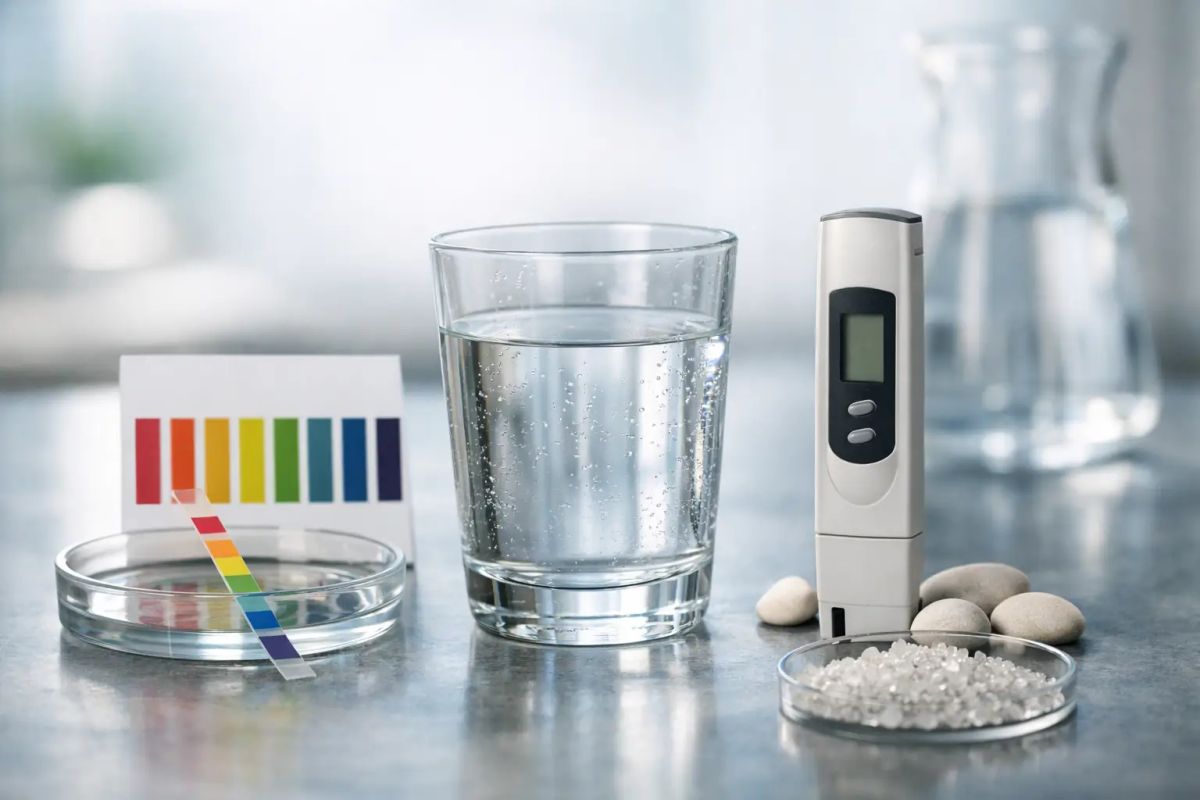
A bottle can carry two numbers that look technical but invite very different questions: pH and TDS. In pH balance vs TDS explained, the essential distinction is simple: pH describes how acidic or alkaline the water is at the time of measurement, while TDS describes the quantity of dissolved material in it. One speaks to chemistry. The other hints at mineral presence, texture, and taste.
Neither number is a universal score for “better” water. A beautifully light, low-mineral spring water may have modest TDS. A mineral-rich water with substantial TDS may feel broad, saline, or softly structured on the palate. The interest lies in learning what the numbers can tell you - and where they stop telling the story.
pH Balance vs TDS Explained: Two Different Measurements
pH measures the concentration of hydrogen ions in water on a scale that generally runs from 0 to 14. A pH of 7 is neutral. Below 7 is acidic; above 7 is alkaline. Because the scale is logarithmic, a shift of one whole pH unit represents a meaningful chemical change, not a small step.
For bottled water, pH can be shaped by source geology, dissolved minerals, and carbon dioxide. Still water exposed to air can absorb carbon dioxide, which can gently lower its pH over time. Sparkling water commonly reads more acidic because its carbonation forms carbonic acid. That is a normal feature of the style, not a verdict on quality.
TDS stands for total dissolved solids. It is typically expressed in milligrams per liter, or mg/L, which is often treated as roughly equivalent to parts per million. The figure represents the total amount of dissolved substances in the water. Depending on the source, those substances may include calcium, magnesium, sodium, bicarbonate, sulfate, chloride, silica, and other naturally occurring compounds.
The key word is total. TDS does not reveal the precise mineral recipe by itself. Two waters can share a TDS of 300 mg/L yet taste completely different: one may be driven by bicarbonate and calcium, the other by sodium and chloride. Their textures, finishes, and food-pairing potential may be far apart.
What pH Can Tell You - and What It Cannot
pH is useful context, particularly when you are comparing still and sparkling styles or noticing how a water presents in the glass. A lower-pH sparkling water can feel bright and lively. A still water with a near-neutral or moderately alkaline pH may read calmer, depending on its mineral composition and carbonation level.
But pH is not a flavor map. It does not tell you whether a water is high in calcium, low in sodium, rich in bicarbonate, or delicate in texture. It also does not measure the amount of acid or alkaline material present. That separate concept is called buffering capacity, and it helps explain why waters with similar pH can behave differently when paired with food.
A pH number is also a snapshot. Temperature, storage conditions, carbonation, and contact with air can influence a reading. When a label lists pH, treat it as a useful reference point rather than an immutable identity. Source information and a mineral analysis add the context that pH alone cannot provide.
A quick note on “alkaline” water
The word alkaline is often used as though it settles the question of a water’s character. It does not. A pH above 7 simply describes where that sample sits on the pH scale. To understand why it sits there, look for the minerals behind it, especially bicarbonate, calcium, magnesium, and sodium. The composition is the more revealing part of the conversation.
What TDS Reveals About Mineral Character
TDS is often the more immediately useful number for someone exploring bottled water by taste. Very low-TDS waters tend to feel light, clean, and understated. They can be refreshing in a minimal, almost weightless way. Higher-TDS waters often bring more presence: a silkier texture, a chalky edge, a savory note, or a lingering mineral finish.
These are tendencies, not rules. TDS is a quantity, not a tasting note. Mineral ratios matter. Calcium can contribute structure; magnesium can bring a faint bitterness; sodium can create a rounder or subtly saline impression; bicarbonate can soften the profile and contribute to a fuller feel. Silica may be present without creating an obvious flavor cue.
A useful way to think about broad TDS ranges is through style, not hierarchy. Water under roughly 50 mg/L is often very low in mineral content. Around 50 to 250 mg/L, many waters show a balanced, approachable mineral profile. Above 250 mg/L, mineral character may become more pronounced. Those ranges are only a starting point. A well-composed 40 mg/L water can be memorable, and so can a 1,000 mg/L mineral water.
TDS also does not equal hardness. Hardness primarily reflects calcium and magnesium, while TDS includes many dissolved substances beyond those two minerals. Nor does a high TDS reading automatically mean a water is salty. You need the sodium and chloride values to understand whether salinity is likely to be part of the experience.
Read the Numbers Together, Not as Rivals
The most revealing approach is to place pH and TDS beside mineral composition and source origin. Consider a still spring water with a pH around neutral and low TDS. It may offer a restrained, crisp profile that lets delicate tea, fresh fruit, or subtle cuisine remain center stage.
Now consider a naturally mineralized water with a higher TDS and substantial bicarbonate, calcium, and magnesium. It may have more body and persistence, making it an interesting companion to richer foods, aged cheeses, or a structured meal. The pH may be useful context, but the mineral panel explains more of the glass.
Sparkling water adds another layer. Carbonation changes texture and can lower measured pH, while mineral content determines whether the bubbles feel sharp, creamy, dry, or saline. A low-TDS sparkling water can be brisk and fleeting. A higher-TDS sparkling water may carry its effervescence with more weight and a longer finish.
There is a world inside every bottle, but it is rarely contained in one number.
How to Use pH and TDS When Choosing Bottled Water
Start with the occasion. For a quiet glass at your desk or a delicate meal, you may prefer a water with low to moderate TDS and a lighter mouthfeel. For dinner, tasting menus, or moments when you want the water to have a distinct point of view, seek a mineral profile with more structure.
Then look beyond the headline figures. If the label provides a mineral analysis, notice calcium, magnesium, sodium, bicarbonate, sulfate, and chloride. You do not need to memorize ideal values. Instead, compare two or three bottles and observe how the compositions correspond with what you taste. A water’s source type - spring, mineral source, artesian source, or otherwise - can add another useful layer of provenance.
Finally, trust the glass. Serve still water cool rather than ice-cold if you want to notice its texture and finish. Taste it before food, then again alongside a dish. With sparkling water, pay attention to bubble size, persistence, and whether the mineral character appears before or after the fizz fades.
Water Sommelier makes this kind of comparison more immediate. Point your phone camera at a bottle, and the app can help identify the product while surfacing available details such as mineral composition, pH, TDS, and source origin. Point. Shoot. Know.
The Most Useful Question Is Not “Which Number Is Best?”
When reading a water label, asking whether pH or TDS is “better” misses the pleasure of the category. pH gives you one view of the water’s chemistry. TDS gives you one view of its dissolved mineral concentration. The mineral panel, source, carbonation, and your own palate complete the picture.
Choose the bottle that fits the moment, then take a second to taste what its numbers suggest. A little attention turns an ordinary pour into a more considered experience.
Scan any bottle. Discover its minerals, origin, and character. Get the Water Sommelier app