
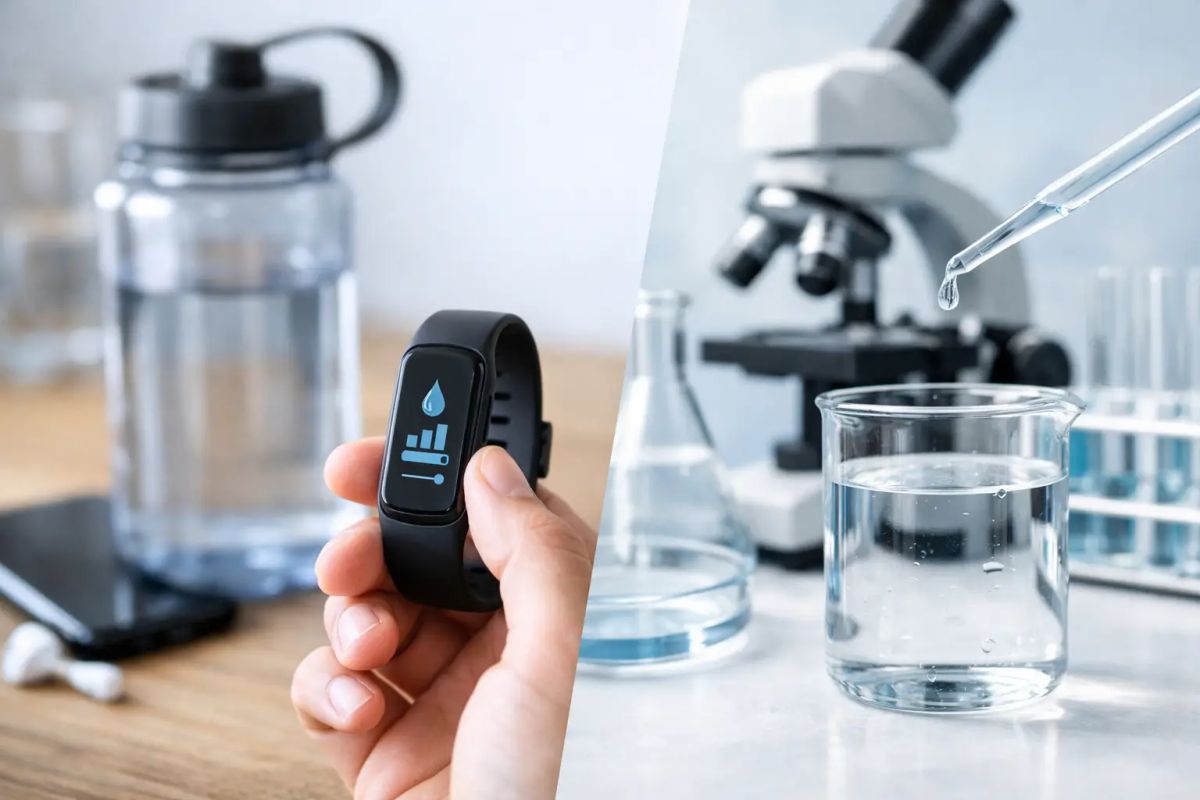
A bottle can tell two very different stories. One is about volume: how much water you logged today. The other is about character: where that water began, which minerals it carries, and how those details shape its profile in the glass. That is the real distinction in hydration tracking vs water analysis.
Both can have a place in a considered routine, but they answer different questions. Confusing them can reduce water to a single number when there is, quite literally, a world inside every bottle.
Hydration Tracking vs Water Analysis: Two Different Questions
Hydration tracking is a recordkeeping exercise. It typically asks how many ounces, glasses, or bottles someone has consumed over a chosen period. Its appeal is immediate: a visual total, a simple log, perhaps a reminder to record another drink. It deals in quantity.
Water analysis is an act of interpretation. It asks what is in a particular bottled water and where it comes from. A useful analysis may surface calcium, magnesium, sodium, bicarbonate, pH, total dissolved solids (TDS), and source origin. It deals in composition.
Neither perspective replaces the other because they are not competing measurements. Logging two bottles does not reveal whether they were identical. One could be a low-mineral spring water with a light, clean profile; the other could be a naturally mineral-rich water with more weight and a pronounced finish. The volume may match. The experience does not.
For people who choose coffee by roast and origin or wine by vineyard and vintage, water analysis creates a more complete vocabulary for an everyday ritual. It turns a label from background packaging into a starting point for attention.
What Hydration Tracking Can and Cannot Tell You
The great strength of tracking is simplicity. It makes a pattern visible. If your goal is to keep a basic record of beverages, a quantity log offers an uncluttered answer: this is what was entered.
But the format has firm limits. An entry labeled “water” treats a bottle from a protected spring, a naturally sparkling mineral water, and a purified bottled water as if they were interchangeable. That may be perfectly adequate when only volume matters. It is incomplete when you are choosing water for flavor, service, sourcing, or a meal.
Tracking also relies on estimation. Bottle sizes vary, glassware is rarely uniform, and a partially finished bottle creates a less precise entry than a sealed one. This is not a flaw so much as the nature of a personal log. It is a useful record, not a technical portrait of the water itself.
The key is to give tracking its proper role. It is about the amount you recorded, not the mineral identity of what was in the bottle.
What Water Analysis Brings Into Focus
Water analysis begins where the intake log ends. Its purpose is not to make a bottle seem complicated. Its purpose is to make its character legible.
Mineral composition
Minerals are part of water's sensory architecture. Calcium and magnesium can contribute to a sense of structure or texture. Sodium may register as roundness or a subtle savory note, depending on the level and the overall composition. Bicarbonate can influence the impression of softness, balance, and finish.
No single mineral tells the full story. What matters is the relationship among them. A water with a modest TDS number can feel delicate and restrained. Another with a higher TDS can feel fuller, more textural, and more lingering. The figures provide context; tasting supplies the final impression.
TDS and pH
TDS, short for total dissolved solids, is often treated as a quality score. It is not. It is a measure of dissolved mineral material, usually expressed in milligrams per liter. Higher or lower is not automatically better. It signals a different style.
A low-TDS water may feel airy and quiet on the palate. A higher-TDS water may have greater presence, mineral detail, or persistence. Whether that suits a particular moment, dish, or personal preference depends on the experience you want.
pH is another figure that benefits from restraint. It describes acidity or alkalinity on a scale, but it does not tell you everything about flavor, mineral balance, or source. Reading pH beside mineral composition and origin is far more revealing than treating it as a standalone verdict.
Origin and source
Source origin gives water its sense of place. It may point to a spring, an aquifer, a mountain region, or another declared source environment. As water moves through rock and soil, it can acquire the mineral signature that distinguishes it from another bottle.
This is why origin belongs in the same conversation as tasting. It gives context to what you perceive. A water is not merely clear liquid in branded glass or plastic. It is a product of geography, geology, and handling.
When Quantity Is Enough, and When Detail Matters
There are moments when hydration tracking is entirely sufficient. If you are maintaining a simple personal record, there is no need to turn every pour into a research project. Clarity can be luxurious too.
Water analysis becomes more valuable when you are selecting between bottles, reading a label in a specialty market, writing a menu, or setting a table with intention. A chef may want a water that feels crisp beside briny seafood. A host might prefer a more structured, naturally mineral-rich option for a rich cheese course. A curious shopper may simply want to understand why one familiar bottle tastes different from another.
For dining professionals, the distinction is especially useful. A volume log has little to say about pairing. Mineral composition, carbonation, texture, and finish are the details that make a water service feel deliberate rather than incidental.
The same is true at home. Instead of asking which bottle is “best,” ask a more interesting question: best for what kind of meal, mood, or taste preference? A quiet still water can be elegant with subtle food. A more assertive mineral profile can hold its own beside bolder flavors. Context changes the answer.
How to Read a Bottle More Intelligently
Start with the source statement. It often establishes whether the water is presented as spring, mineral, purified, or another category. Then look for a mineral analysis, which may be printed on the label or available through product information.
Read calcium, magnesium, sodium, and bicarbonate together rather than isolating a single number. Notice the TDS if it is provided, but treat it as an indicator of style rather than a ranking system. Finally, taste with focus: Is the first impression crisp, soft, round, saline, chalky, neutral, or lingering?
This small ritual changes the experience. You do not need to memorize chemistry to recognize patterns. Over time, you may notice that certain waters feel especially suited to a particular cuisine, temperature, or occasion.
Water Sommelier makes that exploration more immediate. Point your phone camera at a bottle, and the app helps identify the product while surfacing educational details such as mineral composition, pH, TDS, and source origin. Point. Shoot. Know. The purpose is not to replace your own palate, but to give it better context.
The Better Way to Think About Water
The question is not whether hydration tracking or water analysis is more valuable. It depends on what you want to know. Tracking answers a practical question about recorded volume. Analysis answers a richer question about provenance, composition, and taste.
Treat quantity as one piece of the picture, not the entire frame. The next time you reach for a bottle, pause long enough to read beyond the front label. Notice the source. Notice the mineral balance. Take a sip before assigning it a role at the table. A more attentive glass is often where a more interesting water story begins.
Scan any bottle. Discover its minerals, origin, and character. Get the Water Sommelier app