
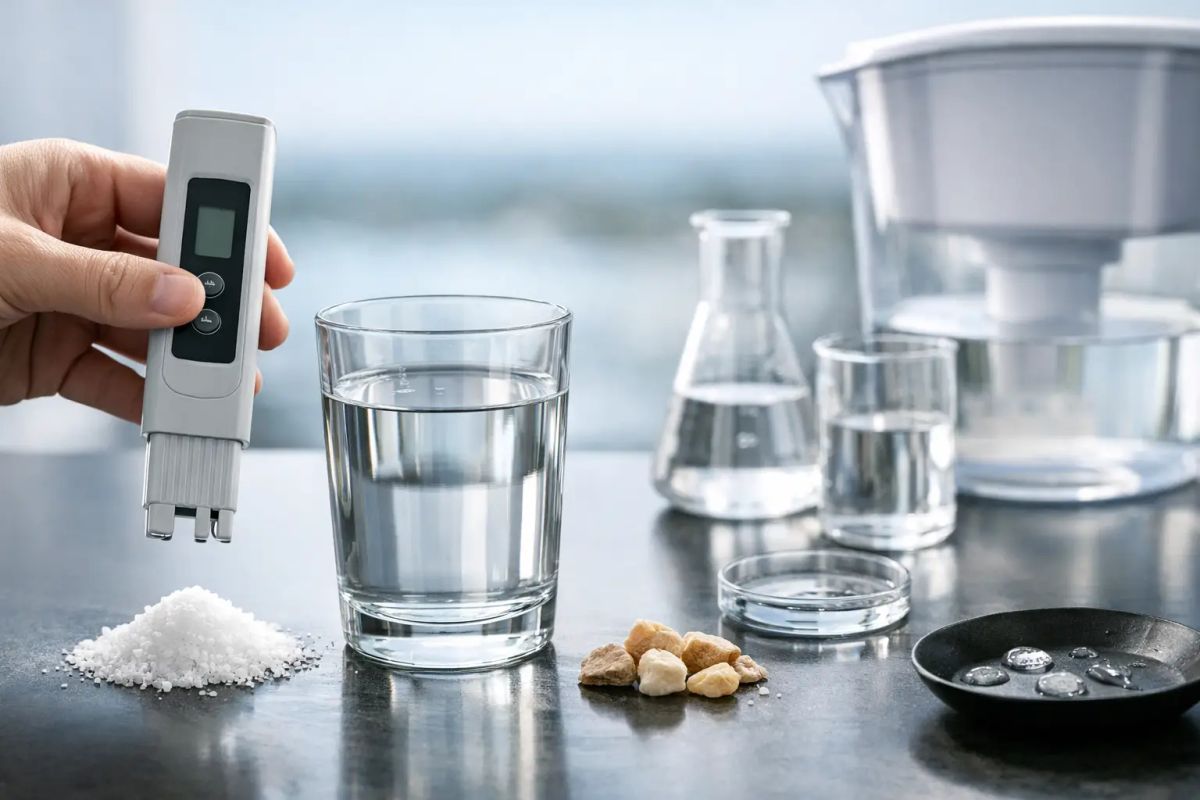
A bottle can look pristine, cold, and expensive - and still tell you almost nothing at a glance. The real story sits in the fine print, often reduced to a small number labeled TDS. If you have ever wondered what is TDS in water, you are really asking a more interesting question: what, exactly, is dissolved in the glass in front of you, and how will that shape taste, texture, and experience?
What Is TDS in Water?
TDS stands for total dissolved solids. It refers to the combined amount of dissolved substances in water, usually measured in milligrams per liter, or mg/L. In bottled water analysis, that number typically reflects naturally occurring minerals such as calcium, magnesium, sodium, potassium, bicarbonate, sulfate, and silica.
TDS does not tell you every detail on its own. It is a headline number, not the full tasting note. Two waters can share a similar TDS and feel completely different on the palate because their mineral compositions are different. One may be crisp and linear, another soft and rounded, another quietly salty.
That distinction matters. TDS is useful because it gives you a fast sense of concentration. But concentration is only one part of character.
What TDS Actually Measures
Think of TDS as the weight of everything dissolved in the water after the pure H2O is set aside. Those dissolved solids are not visible floating particles. They are minerals and compounds integrated into the water itself.
When brands report TDS, they are usually referring to dry residue at a specified temperature or a lab-based estimate of total mineralization. In practical terms, the higher the number, the more mineral content the water contains overall. Lower TDS waters tend to feel lighter and more understated. Higher TDS waters often taste more structured, more present, and sometimes more gastronomic.
Still, more is not automatically better. A low-TDS water can be elegant and refreshing. A high-TDS water can be compelling and deeply expressive. It depends on what you value - delicacy, texture, intensity, salinity, or pairing versatility.
Why TDS Matters for Taste
Water has flavor, and TDS is one of the quickest clues to how pronounced that flavor may be.
A very low-TDS water often presents as clean, airy, and quiet. It may seem almost invisible, which can be ideal in certain settings. If you want water that steps back and lets subtle flavors in tea, spirits, or food remain in full focus, lower mineralization can feel graceful.
As TDS rises, water usually gains more presence. You may notice body, weight, chalkiness, creaminess, salinity, or a firmer finish. Calcium can contribute structure. Magnesium can bring a slight bitterness in some profiles. Bicarbonate can soften acidity and create a smoother impression. Sodium, in balanced amounts, can make water feel rounder and more savory.
This is where water becomes more than a utility. It becomes a sensory ingredient.
Low, Medium, and High TDS - What the Numbers Suggest
There is no single universal scale that captures every nuance, but broad ranges are helpful.
Waters under about 50 mg/L are generally considered very low in dissolved solids. These often taste light, soft, and restrained. Waters between roughly 50 and 250 mg/L tend to offer a balanced middle ground, with enough mineral presence to create character without overwhelming delicacy. Waters above that can become increasingly assertive, textural, and distinctive, especially as specific minerals rise alongside total concentration.
Once you move into much higher numbers, water can start to feel almost culinary in nature. It may pair beautifully with rich dishes, stand up to bold flavors, or leave a memorable mineral finish on its own.
But ranges are only shorthand. A 300 mg/L water rich in bicarbonate will not behave the same way as a 300 mg/L water driven by sulfate and magnesium. TDS tells you intensity. The mineral breakdown tells you personality.
What TDS Does Not Tell You
This is where many people oversimplify the topic. TDS is not a quality score. It is not a verdict on whether a water is premium, pleasurable, or right for your preferences.
A higher number does not mean the water is superior. A lower number does not mean it is empty or inferior. Some of the most refined waters in the world have delicate mineralization and extraordinary elegance. Others are celebrated precisely because they are bold, stony, saline, or almost vinous in structure.
TDS also does not explain source, terroir, or balance on its own. Two waters can have the same total dissolved solids and come from entirely different geological landscapes, producing completely different tasting experiences.
If you care about what is in your bottle, TDS should be your starting point, not your final answer.
How TDS Relates to Mineral Balance
The beauty of mineral water is not just quantity. It is composition.
Calcium often brings firmness and a clean mineral edge. Magnesium can add depth and a faintly bitter snap. Sodium can create softness and a savory lift. Bicarbonate often rounds the palate and changes the way water interacts with food, especially acidic dishes. Silica can make some waters feel smooth, almost silky.
This is why trained tasters do not stop at the TDS number. They look at the balance between minerals and the overall sensory effect. A water with moderate TDS but excellent balance can feel more complete than a water with very high TDS and a less harmonious profile.
In the same way a wine drinker cares about acidity, tannin, and texture rather than alcohol alone, a water-aware drinker learns that total dissolved solids are only one dimension of quality.
What Is a Good TDS in Water?
The honest answer is that it depends on context.
If you want an all-day water with a discreet profile, lower to moderate TDS may feel best. If you enjoy minerality you can actually taste, a moderate to high TDS water may be more satisfying. If you are pairing water with food, the right choice changes again. Delicate seafood, fresh fruit, and mild cheeses often benefit from gentler waters. Rich meats, aged cheeses, and boldly seasoned dishes can handle waters with more structure and mineral grip.
There is also personal preference. Some people love a water that disappears. Others want one that announces itself.
So rather than asking for a universally good number, ask what kind of experience you want from the bottle.
How to Read TDS More Intelligently
When you see a TDS number on a label, read it as an invitation to look deeper. A low number suggests restraint. A high number suggests presence. Then ask what minerals are creating that result.
That second step changes everything. It moves you from a basic metric to actual understanding.
This is especially useful if you are comparing bottled waters for taste, culinary use, or personal preference. A water with 35 mg/L TDS and one with 350 mg/L TDS are likely serving very different roles. Neither is automatically right. They are simply designed by nature for different expressions.
If you want to make this easier, Water Sommelier helps decode bottled water at a glance by showing not just TDS, but the mineral composition behind it - the part that explains why one water tastes soft and another tastes vivid, saline, or structured.
Why the Question Matters More Than Ever
Water is often treated as blank space between coffee, wine, and food. It is not. There is a world inside every bottle, shaped by rock, time, source, and mineral contact.
TDS matters because it gives that world a visible number. It turns vague impressions into something measurable. More importantly, it opens the door to better questions. Not just how much is in this water, but what is in it. Not just whether it is mineralized, but how those minerals will land on the palate.
Once you start reading water this way, labels become more than packaging. They become maps.
The next time you pick up a bottle, pause at the TDS. Let it be the beginning of your curiosity, not the end of it.
Scan any bottle. Discover its minerals, origin, and character. Get the Water Sommelier app