
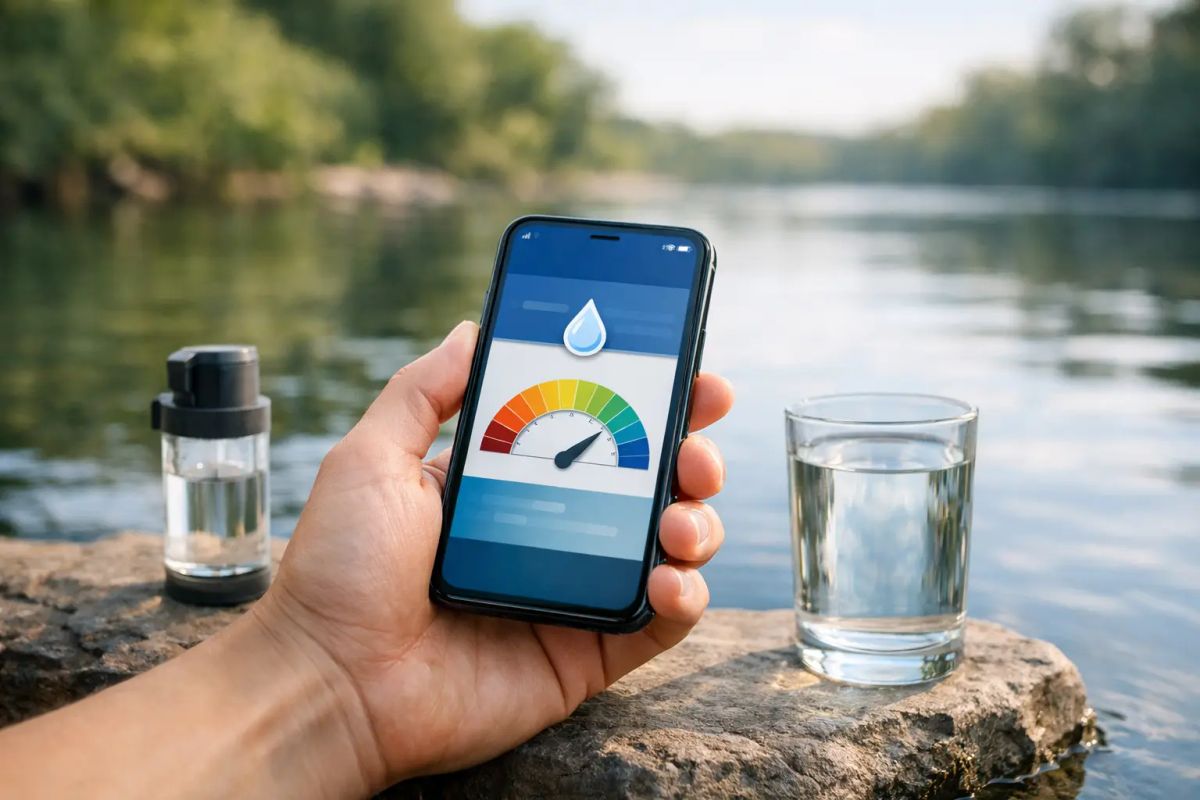
A bottle labeled 7.8 can look reassuring. A bottle labeled 6.5 can look suspicious. Yet if all you know is pH, you are reading one line from a much longer story. That is where a water pH app becomes genuinely useful - not as a novelty number checker, but as a way to understand what gives a water its structure, taste, and character.
People often search for pH because it feels definitive. Acidic or alkaline. Good or bad. High or low. Water is rarely that simple. The most interesting bottles on the shelf are shaped not only by pH, but by calcium, magnesium, sodium, bicarbonate, total dissolved solids, and source geology. If you care about what you drink, pH is a starting point. It is not the whole tasting note.
What a water pH app should actually help you understand
The best use of a water pH app is context. pH tells you how acidic or alkaline water is on a scale, but it does not tell you why that number exists, how stable it is, or how the water will feel on the palate.
Two waters can sit close together on the pH scale and taste completely different. One may feel crisp and light. Another may feel round, chalky, or quietly savory. That difference usually comes from mineral balance rather than pH alone. Calcium can add firmness. Magnesium can sharpen the profile. Bicarbonate can soften acidity and influence perceived smoothness. Sodium can make a water feel broader and more gastronomic.
So when someone asks, "What is the pH of this water?" the better question is often, "What kind of water is this overall?" A useful app should answer both.
Why pH alone is a limited signal
pH has become a headline metric because it is easy to market. It fits neatly on packaging and in wellness conversations. But acidity and alkalinity are only one dimension of quality, and sometimes not the most important one.
A water with a higher pH is not automatically more refined, more flavorful, or more suitable for your preferences. Likewise, a lower-pH water is not automatically inferior. Source matters. Mineral content matters. Even the intended use matters. A delicate still water you enjoy on its own may not be the same bottle you would want next to a mineral-driven meal.
There is also the question of sensory expectation. Many people assume pH predicts taste directly. In practice, taste is mediated by the whole mineral matrix. A bottle with moderate pH and balanced bicarbonate can feel silkier than one with a higher pH but less harmony in its composition. This is where data becomes meaningful only when it is interpreted.
The difference between measurement and interpretation
Some people imagine a water app as a digital pH strip. Point, scan, get a number. That has limited value unless the app can place the number inside a broader profile.
Interpretation means showing how pH interacts with TDS, source, and minerals. It means helping you understand whether a water is light and neutral, structured and food-friendly, or bold and mineral-rich. It means translating chemistry into something lived - what you will notice in the glass, what foods the water sits well beside, and what kind of drinker tends to prefer it.
This is especially useful for people who buy bottled water intentionally. If you are comparing options at a retailer in New York, Los Angeles, or Miami, a plain pH value will not tell you much about the experience of each bottle. An interpreted profile gives you a clearer reason to choose one over another.
How a water pH app fits modern drinking culture
Water has quietly entered the same conversation once reserved for coffee, wine, and olive oil. People want provenance. They want composition. They want to know why one bottle feels bright and another feels velvety.
A water pH app fits this shift because it turns labels and numbers into literacy. For health-conscious consumers, that may mean understanding mineral intake with more precision. For athletes, it may mean selecting water with a composition they prefer before training or recovery. For dining professionals, it may mean choosing a bottle that supports rather than flattens a dish. For premium lifestyle consumers, it is part of a broader instinct to choose with intention.
The cultural change here is subtle but significant. Water is no longer just a utility purchase. For a growing number of people, it is a curated one.
What to look for in a better water pH app
If an app only shows pH, its usefulness fades quickly. The stronger experience is one that treats pH as part of a complete identity.
Look for an app that reveals full mineral composition, including calcium, magnesium, sodium, and bicarbonate, alongside TDS and source origin. That combination helps explain both technical structure and sensory style. If the app also translates that information into tasting notes or pairing guidance, it becomes far more practical in daily life.
This is why Water Sommelier feels more relevant than a simple numeric tool. Point your phone camera at a bottle and the app identifies the water, then reveals not only pH but the mineral architecture behind it, plus tasting profile, source details, compatibility guidance, and food pairing suggestions. The experience is immediate, but the value is depth.
That depth matters because choosing water is often about preference, not ideology. Some people want a clean, low-mineral profile for all-day drinking. Others enjoy waters with greater texture and salinity at the table. A well-designed app respects that there is no single perfect bottle for every person or every moment.
Water pH app results need nuance
One of the most common mistakes is treating pH as a score. Higher does not always mean better. Lower does not always mean worse. The right reading depends on what you want from the bottle and how the other elements are balanced.
There is also a sensory trade-off. A highly mineralized water can be fascinating, layered, and memorable, but it may feel too assertive if you want something neutral. A lighter water may feel elegant and versatile, but it may not offer the same depth at the table. pH contributes to this impression, yet it does not govern it alone.
That is why context is everything. When an app shows pH next to TDS and major minerals, you can read the bottle with much more confidence. You stop chasing a number and start understanding style.
Who gets the most value from this kind of app
For the ingredient-conscious drinker, a water pH app can make labels more legible and choices more precise. For the wellness-minded user, it offers information without turning water into a vague trend. For athletes, it can support more intentional product selection based on composition. For sommeliers, chefs, and food writers, it opens a richer language around pairing and palate.
And for anyone who has ever stood in front of a shelf of premium water wondering why one bottle costs more than another, the answer often begins with origin and mineral identity. There is, quite literally, a world inside every bottle.
The future of water intelligence is not just pH
The most interesting apps in this category will move beyond isolated metrics. They will help people recognize patterns in what they enjoy. Maybe you consistently prefer waters with softer mineral balance and lower TDS. Maybe you gravitate toward bottles with more bicarbonate and a broader mouthfeel. Maybe your preferences shift depending on whether you are drinking water alone or with food.
That is where digital water knowledge becomes genuinely personal. A single pH reading can inform. A profile built over time can educate your palate.
This matters because drinking preferences are rarely static. The water that feels perfect during a busy afternoon may not be the one you want beside oysters, espresso, or a long dinner. As people become more fluent in water, they tend to become less interested in one-dimensional rankings and more interested in fit.
A thoughtful water pH app should make that shift easier. It should help you see the number, understand the composition, and choose with a little more clarity than you had a moment before.
The best part is that once you start reading water properly, the shelf changes. Labels become more than branding. Numbers become character. And each bottle stops being just water and starts becoming exactly what it is - a source, a structure, a taste, and a choice.
Scan any bottle. Discover its minerals, origin, and character. Get the Water Sommelier app