
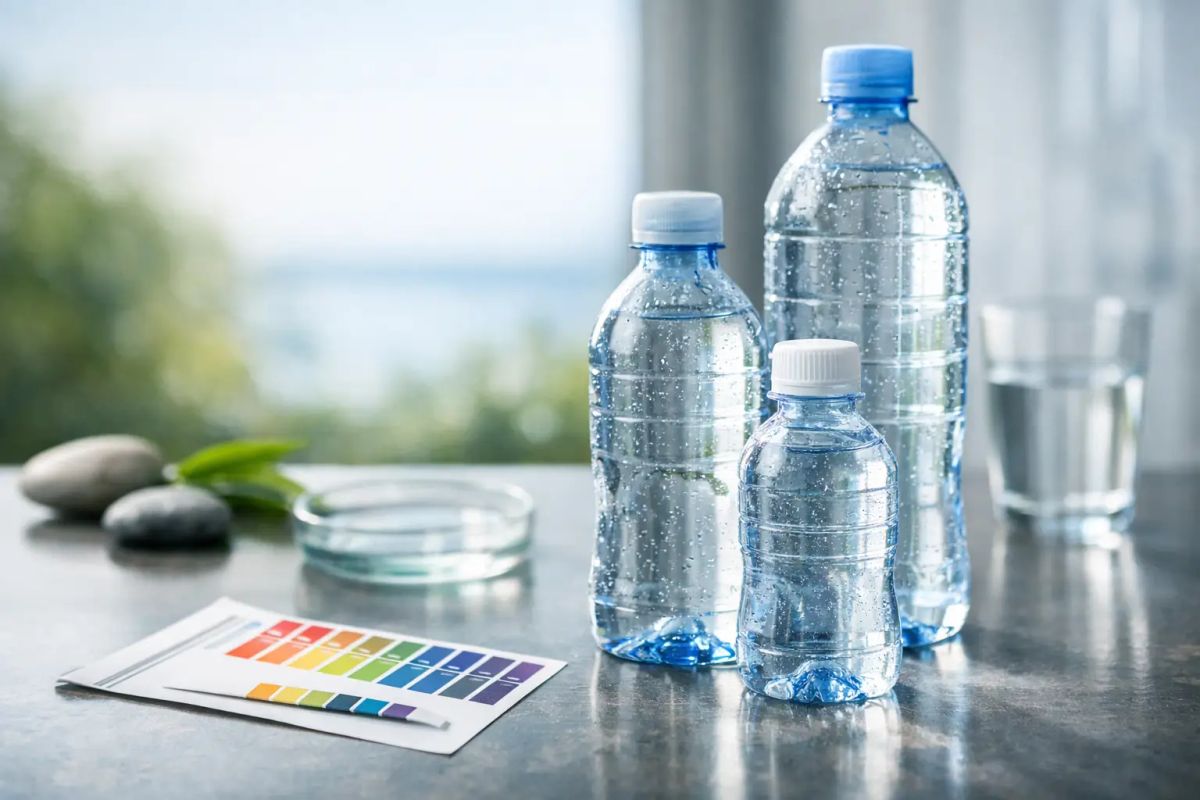
A bottle marked pH 8.8 can look more impressive than one marked pH 7.2. But pH is not a scorecard, and the higher number does not automatically make a water more refined, more mineral-rich, or better suited to every occasion. This guide to bottled water pH levels helps you read that number in context, alongside the source, mineral profile, and taste in your glass.
There is a world inside every bottle. pH is one useful detail in that world, but it is only one detail.
What bottled water pH actually measures
pH measures how acidic or alkaline a water is on a scale from 0 to 14. A pH of 7 is considered neutral. Below 7 is acidic; above 7 is alkaline. The scale is logarithmic, which means a one-point shift represents a meaningful change in hydrogen ion activity, not merely a small step up or down.
In bottled water, pH may reflect the water's natural journey through rock and soil, its dissolved mineral content, its contact with carbon dioxide, or post-source treatment. That last point matters. Two waters with the same pH can arrive there in very different ways.
A naturally sourced mineral water may gain its pH character as it moves through limestone or other mineral-bearing formations. A purified water may be adjusted after processing. Neither route is inherently superior. The more useful question is whether the label and mineral analysis tell a coherent story about what is in the bottle.
A practical guide to bottled water pH levels
Most still bottled waters sit somewhere near neutral, often roughly between pH 6.5 and 8.5. This is a broad, familiar range, and it contains waters with radically different personalities.
Below pH 7: brighter, sometimes softer waters
A slightly acidic bottled water is not necessarily a problem. Natural dissolved carbon dioxide can lower pH, especially in sparkling water, and some low-mineral still waters may also read below neutral. On the palate, these waters can feel crisp, light, and clean, with a quick finish.
For sparkling water, a lower pH is particularly unsurprising. Carbon dioxide dissolves in water and forms carbonic acid, creating the lively bite that makes carbonation feel refreshing. Comparing the pH of a sparkling water directly with a still mineral water is rarely useful because their sensory goals are different.
Around pH 7: clean and neutral territory
Waters near neutral are often perceived as restrained and versatile. Their taste may be delicate, but neutral pH alone does not guarantee a neutral flavor. Calcium, magnesium, sodium, bicarbonate, silica, and total dissolved solids all influence what you notice on the palate.
A low-TDS water near pH 7 may feel airy and almost weightless. A higher-TDS water at nearly the same pH may feel rounded, chalky, saline, or structured. The number is the opening note, not the full composition.
Above pH 7: alkaline, but not automatically mineral-rich
An alkaline bottled water has a pH above 7. Some are naturally alkaline because of their geology, commonly with bicarbonate and calcium or magnesium present. Others are purified waters whose pH has been raised through an added process.
The distinction is worth seeking out if you care about provenance and taste. Natural alkalinity often comes with a discernible mineral signature and a sense of weight on the palate. Process-adjusted alkalinity may present very differently, particularly when total dissolved solids remain low.
A pH of 9 or higher is a statement about acidity and alkalinity, not a complete verdict on quality. Read it with the mineral panel, source description, and TDS figure before deciding whether it belongs in your regular rotation or on a particular table.
pH and alkalinity are not the same thing
These terms are often treated as interchangeable, but they describe different properties. pH is a snapshot of how acidic or alkaline water is at the moment of measurement. Alkalinity is water's capacity to resist changes in pH, often associated with bicarbonate, carbonate, and mineral content.
Think of pH as the reading on the dial and alkalinity as part of the system behind it. A water can have a moderately alkaline pH without especially high alkalinity, while a bicarbonate-rich water may have a strong buffering character even if its pH does not seem extreme.
For tasting, bicarbonate often matters because it can contribute softness, roundness, and a lingering, gently savory finish. For label-reading, it explains why a single pH number is never enough to describe a water's character.
Why the same pH can taste completely different
Imagine two still waters, each with a pH of 7.8. One is very low in dissolved solids. It may taste soft, clean, and fleeting, leaving almost no mineral impression. The other has substantial calcium, magnesium, and bicarbonate. It may feel fuller in texture, with a faint mineral dryness and a longer finish.
This is where TDS becomes useful. Total dissolved solids indicates the overall amount of dissolved minerals, expressed in milligrams per liter. It does not identify which minerals are present, so it is not a quality grade. Still, it offers a fast clue about concentration and body.
Then look at the individual minerals. Calcium can lend structure. Magnesium may read as dry, bitter, or pleasantly mineral depending on concentration and personal preference. Sodium can create a subtle savory lift. Bicarbonate can soften acidity and broaden the mid-palate. Together, they make water feel more like a beverage with a point of view.
How to read a bottled-water label with more confidence
Start with the source. Spring, mineral, artesian, purified, and sparkling waters can all be compelling categories, but they signal different origins and production paths. A clear source statement gives the pH number more context.
Next, find the pH and ask a simple question: does it fit the rest of the profile? A water described as naturally mineral-rich may reasonably show a fuller mineral panel and measurable TDS. A very high pH paired with nearly no listed minerals may indicate that alkalinity comes from processing rather than the source.
Then read the water through your own preferences. If you enjoy delicate tea, a low-mineral, near-neutral water may let floral and nuanced notes speak clearly. If you are serving rich food, a structured, bicarbonate-forward mineral water can offer a satisfying contrast. Sparkling water with lively acidity can bring energy to fried dishes, salty snacks, or a celebratory aperitif.
This is not a hierarchy. It is curation.
Does pH change after bottling?
It can. pH is sensitive to temperature, dissolved gases, exposure to air, and the measurement method. Once a bottle is opened, carbon dioxide can escape from sparkling water, shifting its character over time. Even still water may show small variation depending on storage and testing conditions.
That is why pH should be treated as an informative label value, not laboratory theater. A difference of a few tenths between a bottle label and a home test does not necessarily mean something is wrong. It may simply reflect the realities of measuring water outside the bottling line.
For the clearest picture, consider pH alongside source origin, TDS, calcium, magnesium, sodium, and bicarbonate. Water Sommelier makes that broader read simple: point your camera at a bottle, then see the composition behind the number and begin building a tasting memory around it.
Choosing by occasion, not by the biggest number
The best bottled water pH level depends on what you value in that moment. For a quiet desk-side water, you may prefer a soft, low-mineral profile that disappears gracefully. For a meal, you may want a more structured water that holds its own beside food. For sparkling service, brightness and texture may matter more than an alkaline claim.
Treat pH as a compass rather than a destination. It can point toward a water's style, but the source and minerals tell you where that water has been. The most memorable bottle is often not the one with the boldest number on its label, but the one whose character feels exactly right in the glass.
Scan any bottle. Discover its minerals, origin, and character. Get the Water Sommelier app