
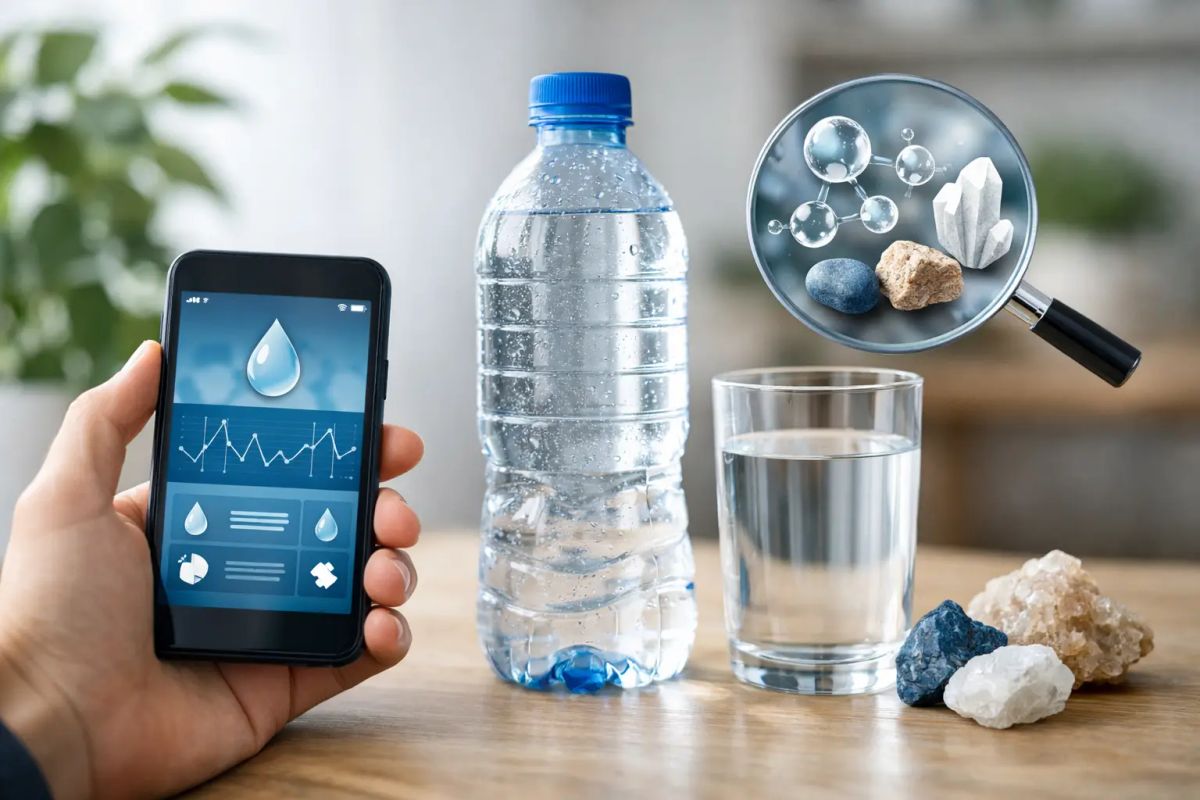
You are standing in front of a wall of bottled water. The labels promise purity, balance, origin, and taste. Some mention calcium. Others highlight alkalinity. A few gesture toward rare springs and volcanic rock. Most people pick by habit or by design. A mineral water app changes that moment. It turns the bottle in your hand into something readable.
That shift matters more than it sounds. Water is often treated as neutral, almost invisible, yet it carries structure, character, and composition. The difference between a low-mineral spring water and a dense, bicarbonate-rich sparkling water is not cosmetic. It affects flavor, mouthfeel, pairing, and how the water fits into your preferences. If you care about what is in your glass, guessing is a poor standard.
Why a mineral water app matters
A good mineral water app does not reduce water to a single score. It gives context. It helps you understand what calcium, magnesium, sodium, and bicarbonate actually mean in relation to one another, and why pH or TDS only tell part of the story.
For a health-conscious buyer, that context can support more intentional choices without drifting into pseudoscience. For an athlete, it can make bottled water selection less random. For a sommelier, chef, or food writer, it opens a more precise language around pairing and sensory character. For the premium consumer, it simply answers a reasonable question: what exactly am I paying for?
Water has terroir. It has texture. It can feel soft, chalky, crisp, saline, round, or bright. The right app helps translate those qualities from technical data into a form you can use.
What a mineral water app should actually show
The first job is obvious. It should identify the water and present its mineral profile clearly. That means calcium, magnesium, sodium, bicarbonate, and ideally sulfate and chloride when available. These are not decorative figures. Together, they shape both taste and perceived structure.
Calcium often contributes firmness and a subtle chalky edge. Magnesium can sharpen the palate and add a slight bitterness at higher levels. Sodium, in the right proportion, can make a water feel softer or more rounded. Bicarbonate is especially important in sparkling waters and can create a creamy, buffering effect that changes how a water behaves with food.
Beyond minerals, pH and TDS belong in the picture, but not as headline drama. Consumers are often taught to fixate on those two numbers. That is too simplistic. A high pH does not automatically make one water better than another. TDS tells you the total mineral load, but not whether that load creates elegance or heaviness. A refined app explains these measures without overselling them.
Source origin also matters. Not because every spring story needs romance, but because geology shapes composition. Water moving through limestone, volcanic rock, or deep aquifers develops different mineral signatures. If the app includes source details, it should connect origin to taste and style rather than leaving it as marketing scenery.
The best mineral water app goes beyond analysis
Data alone is rarely memorable. Utility comes from interpretation.
The most useful mineral water app should help you understand what a profile feels like in the mouth. Is the texture light and quick, or dense and lingering? Is the finish clean, savory, mineral, or slightly saline? A tasting profile turns chemistry into experience. That is where people stop scrolling past numbers and start learning how to choose.
Food pairing is another sign that an app understands water as a category, not a commodity. A delicate still water may sit beautifully beside raw seafood or fresh cheese. A more assertive sparkling water with higher bicarbonate can stand up to rich dishes and reset the palate between bites. Not every user needs pairing guidance every day, but for dining professionals and curious hosts, it is the difference between information and application.
Personalization matters too. A strong app should remember what you like, what you have tasted, and what patterns are emerging. If you repeatedly prefer lower sodium still waters with moderate calcium, that preference should become useful. If you lean toward energetic sparkling waters with more mineral tension, the app should recognize that. Taste becomes more interesting when it leaves a trail.
Camera scanning changes the experience
The best feature in this category is also the simplest: point your phone at a bottle and get the answer quickly.
That matters because bottled water decisions happen in motion. In a grocery aisle, at a hotel, before service, on a flight connection, or while choosing a bottle for dinner, nobody wants to manually search through long product pages. A camera-based experience respects the moment. Point. Shoot. Know.
There is a practical advantage here as well. Labels vary wildly in readability. Some display a full analysis panel. Others bury key figures in small type or omit useful interpretation. A scan-based app removes friction and makes the experience feel immediate.
This is one reason Water Sommelier stands out as a compelling example of what the category can be. It does not merely identify a bottle. It reveals mineral composition, pH, TDS, source origin, compatibility guidance, pairing ideas, and a personal tasting profile in one elegant motion. That is a very different proposition from treating water as a barcode and a name.
Who benefits most from using a mineral water app
Not every user arrives with the same question, and that is exactly why the category has room to grow.
For wellness-minded consumers, the appeal is clarity. They want to know what is in the bottle without reading chemistry tables like a lab report. For biohackers and routine optimizers, the value is precision. They may track intake patterns and prefer waters with a certain mineral style depending on the setting.
Athletes often approach bottled water functionally, but taste still matters. A water that is technically mineral-rich but unpleasant to drink will not become a favorite. An app can help narrow options that align with both preference and composition.
For hospitality professionals, the use case is richer still. Fine dining already takes wine, coffee, tea, and spirits seriously. Water belongs in that conversation. Pairing the wrong water with a dish can flatten subtle flavors or add unnecessary intensity. Pairing the right one can sharpen contrast, cleanse the palate, or echo a dish's mineral notes.
Then there is the premium lifestyle audience, especially in cities like New York, Los Angeles, Miami, and San Francisco, where consumption is often part of identity. These users are not looking for more noise. They want discernment. A well-designed app gives them a language for taste that feels intelligent, not performative.
What to watch for before you trust an app
Not every app experience deserves your attention. Some rely too heavily on broad claims, vague ratings, or the idea that one number determines quality. Water is more nuanced than that.
Look for balance between clarity and depth. If an app only shows a single wellness score, it is probably hiding the interesting part. If it floods the screen with raw figures and no interpretation, it may be technically complete but practically weak.
Database quality is another factor. The app should include a broad range of bottled waters and update regularly enough to stay useful. Global coverage matters if you travel or buy imported brands, but accuracy matters more than sheer volume.
Design also carries weight. Premium information should not feel cluttered. A mineral water app works best when it makes complex data feel calm, legible, and immediate. That is especially true for first-time users, who may be curious but not yet fluent in the language of water.
The larger shift behind the category
A mineral water app reflects a cultural change. People no longer accept opacity in categories they use every day. They want provenance, composition, and a clearer sense of quality. Coffee drinkers ask about altitude and roast profile. Wine drinkers ask about vineyard and vintage. Water is beginning to receive the same attention.
That does not mean every bottle needs ceremony. It means the category finally has room for intelligence.
There is a world inside every bottle, but most labels only whisper it. The right app makes that world legible. And once you start reading water properly, it becomes very hard to go back to choosing blind.
Scan any bottle. Discover its minerals, origin, and character. Get the Water Sommelier app